Composite Stepped and Scarf Repair Fabrication
Fabricating a substrate laminate is only part of the work. Understanding how to repair one is where process knowledge is tested. This section covers the preparation and execution of structural composite repairs, with stepped and scarf joint geometries evaluated against each other as repair approaches.
Joint Selection: Step vs. Scarf
Two joint geometries are common in composite repair practice. A scarf joint tapers the damaged material down to a feathered edge, distributing load across a continuous gradient. A stepped joint removes material in discrete incremental rings, each step exposing a new ply for bonding. Scarf joints offer superior load transfer and are preferred for structurally critical repairs, but they demand precise execution and are best performed by a skilled technician with controlled tooling. Stepped joints are more forgiving to prepare and are repeatable enough for lab qualification work, which made them the primary geometry for this trial.
Substrate Preparation
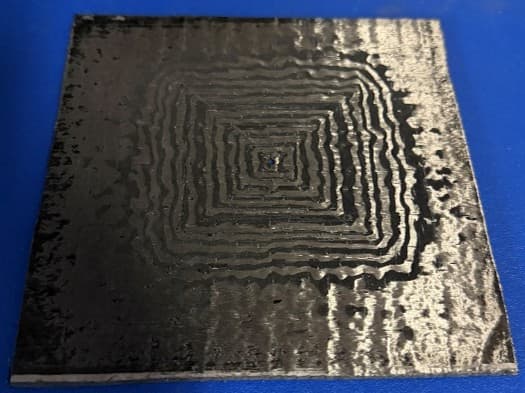
The 24-ply quasi-isotropic laminates fabricated earlier served as the repair substrates. A small-diameter hole was drilled first to simulate the initial damage site. From there, each step was cut using a handheld router with diameter and depth jigs, working outward from the damage at an approximate taper ratio of 20:1. Each step exposed a defined ply depth at a corresponding diameter, producing a clean bonding surface at every level of the laminate (Figure 1).
The preparation process surfaced a known challenge in field repair work: the outermost steps of a deep laminate are extremely thin, and maintaining clean geometry at those depths with handheld tooling is difficult. On some samples the final step was cut through. Angle die grinders with sanding disks were also evaluated as an alternative preparation method. That approach allows a more visual and tactile gauge during material removal and is better suited to producing scarf geometry or handling complex part contours. Neither method is universally superior. Step routing with jigs is more repeatable on flat panels; die grinding is more adaptable to geometry. A combined approach, selected based on part shape and repair classification, is the practical direction for future work.
Repair Layup and Cure
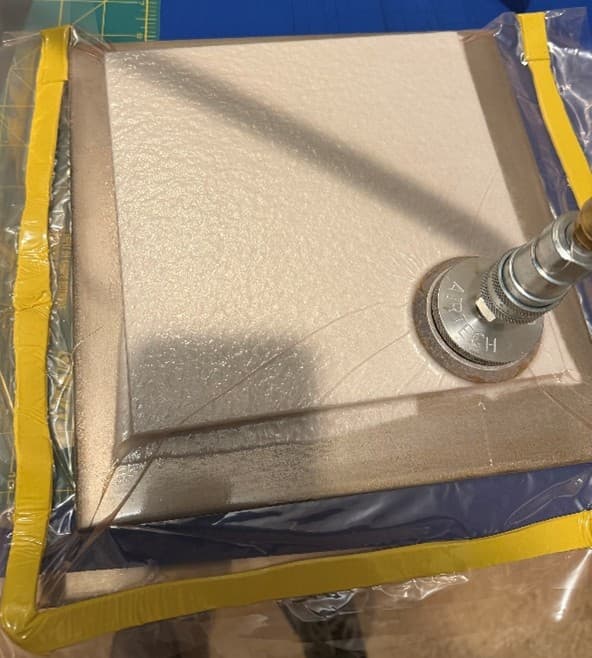
Once the substrate was prepared, the repair patch can be applied using wet layup directly onto the stepped bonding surfaces, or using pre-cut plies staged to size that tack into position before bagging. For these repairs a proprietary prepreg was utilized for repair. A caul plate was placed over the repair stack to distribute pressure evenly across the repair surface during cure. The assembly was vacuum bagged and oven cured at elevated temperature (Figure 2).
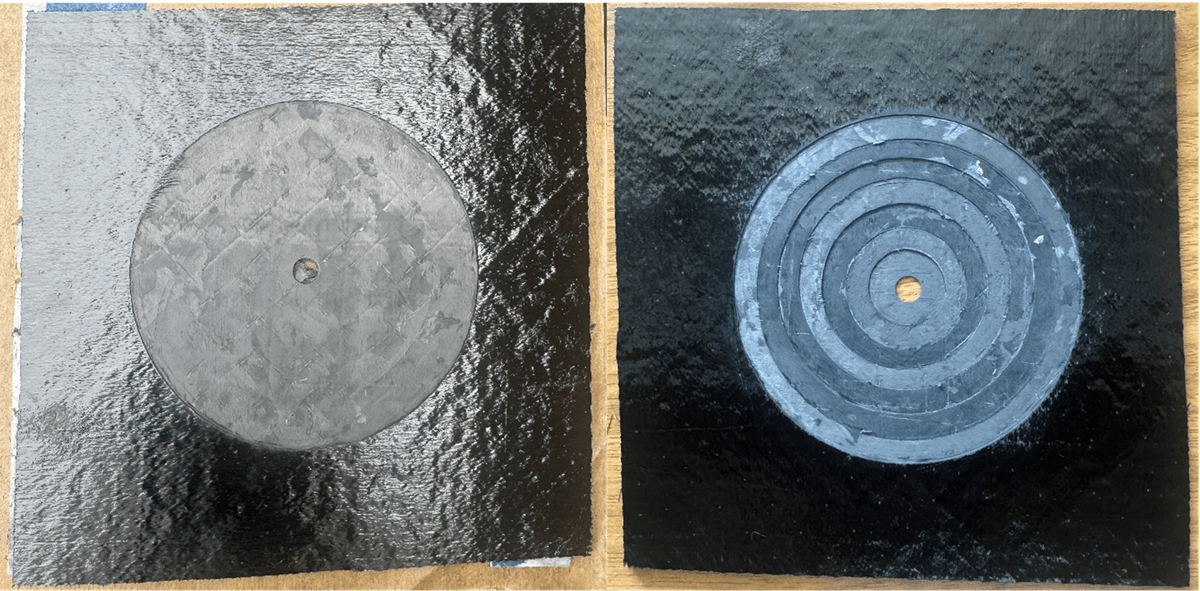
A secondary repair method, scarf repair, was also evaluated using a heated press to apply direct heat and controlled pressure, confirming that the patch material bonds effectively through conductive heat as well as oven cure (Figure 3). The repaired laminates were subsequently waterjet cut into short beam shear coupons for mechanical testing alongside unrepaired baseline material.